
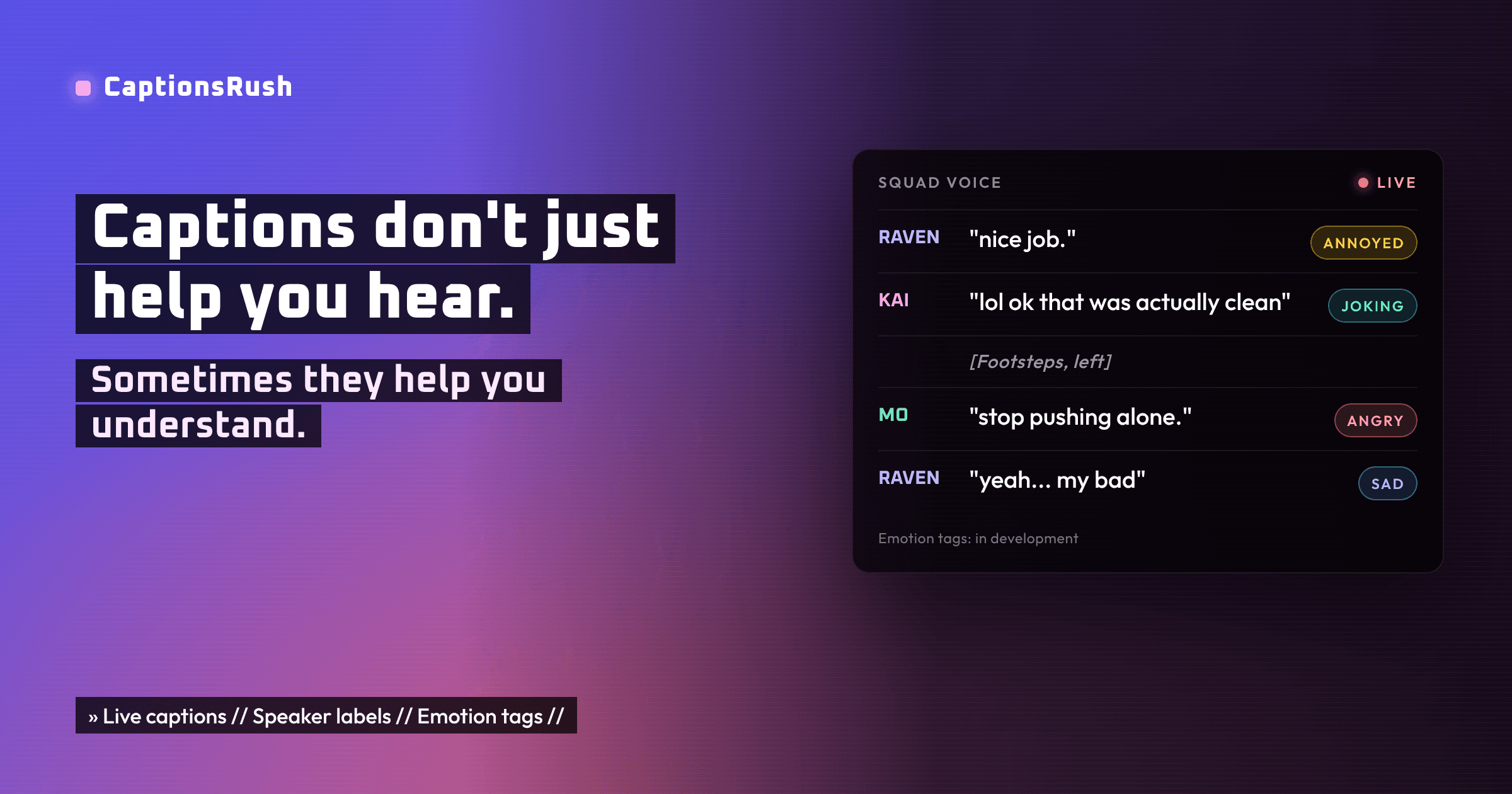
Captions Don't Just Help You Hear. Sometimes They Help You Understand.
We built CaptionsRush for deaf and hard of hearing gamers. That was the whole idea at the start: you're in a squad, someone's calling out an enemy position or asking for a revive, and if you can't hear it you're basically playing alone. CaptionsRush puts that voice chat on your screen as it happens, in 60 languages, with the sound cues tagged too. Today most of our users are still deaf and HoH players, and honestly they're the reason we keep building.
Lately though we've been thinking a lot about another group of players who might get just as much out of captions, and for a pretty different reason. Autistic gamers.
Voice chat moves fast. People talk over each other, they joke, they get irritated, and most of what they actually mean is carried in how they say things rather than what they say. A flat "nice job" can be a compliment or a dig, and you're expected to know which one in half a second. For alot of autistic people that part is harder, and there's solid research on it. A 2025 meta-analysis that pooled 29 studies found a moderate to large gap between autistic and non-autistic people in recognizing emotion from tone of voice alone (Hedges' g = -0.65). Another meta-analysis looked at alexithymia, which is trouble identifying and describing your own feelings. Across nine studies it turned up in about half of autistic participants (49.9%) versus under 5% of neurotypical ones, roughly 6.5 times the risk. None of this applies to every autistic person, and plenty of people on the spectrum read tone just fine. But if you do find it hard, a loud five person call in the middle of a match is about the worst place to be doing that work.
So where do captions come in? Mostly they take the pressure off. When the words are sitting on screen, seperated by speaker, you don't have to catch everything live. You can glance back, reread a line, take a second. That frees up some headspace for the harder question of what the person meant. Captions on their own can't tell you somebody's annoyed with you. They do make sure you didn't miss the sentence while you were trying to work that out.
We want to go further, and this is the part we're excited about. We're currently developing tech that shows the feeling behind a line right next to the caption, things like angry, sad or annoyed. It runs on a deterministic model. It anchors on specific words and phrases and maps them to the feeling they're usually tied to, so it isn't a black box guessing at your mood. It follows the same rules every time, and you can see why it labeled something the way it did. We're starting with gaming because that's where we live, but we can already see it being useful in a lot of other places too, like work calls, group chats or a busy family dinner.
That's where CaptionsRush is headed. Making games easier to hear was step one. Making the people in them a bit easier to read is next.
Sources: Luo et al., "Emotional Prosody Recognition in Autism Spectrum Disorder Without Intellectual Disability: A Systematic Review and Meta-Analysis," Journal of Autism and Developmental Disorders (2025). Kinnaird, Stewart & Tchanturia, "Investigating Alexithymia in Autism: A Systematic Review and Meta-Analysis," European Psychiatry (2019).